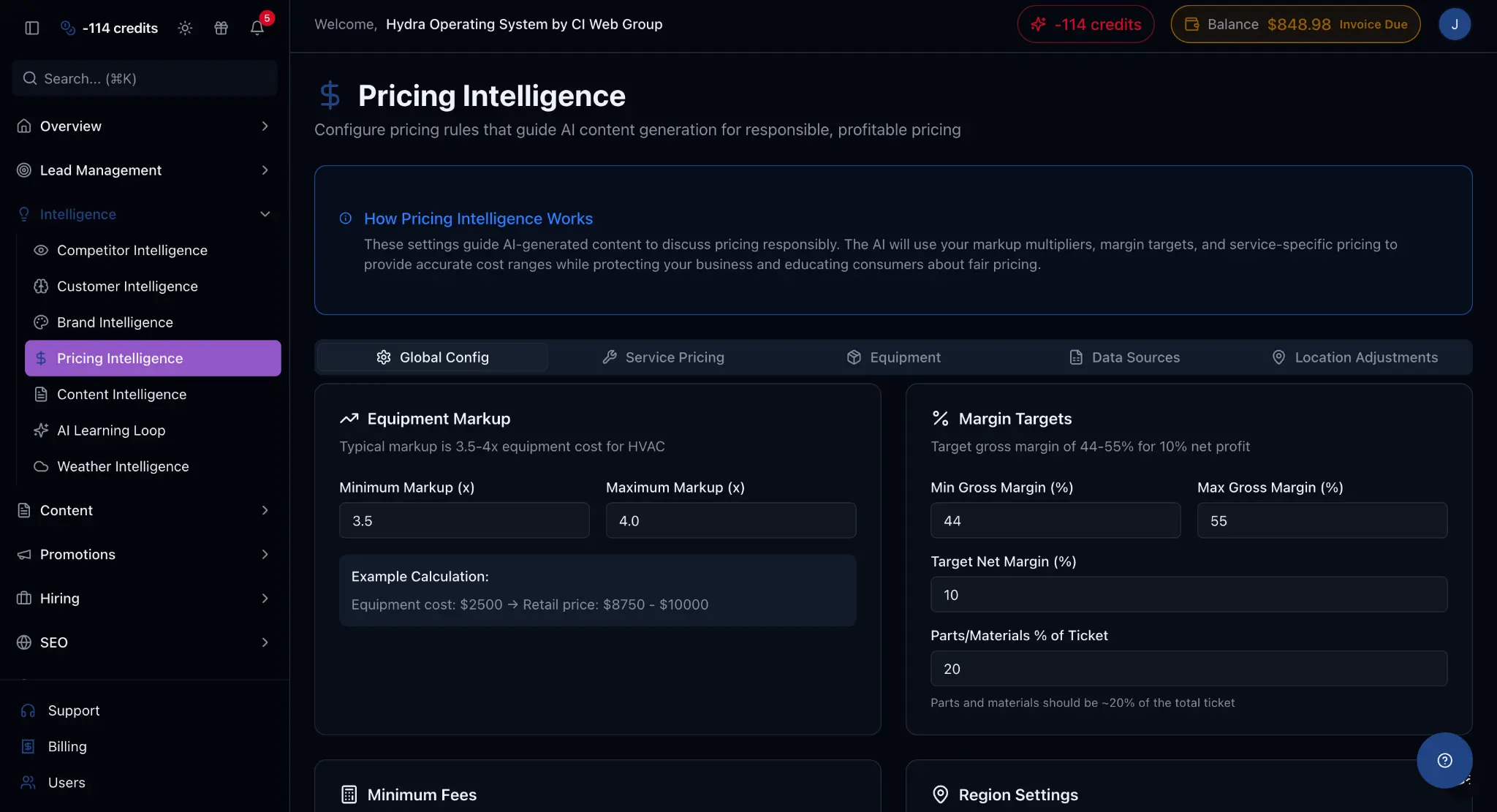
Equipment markup optimized: 3.5-4x multiplier | Target margin: 44-55% gross•Equipment markup optimized: 3.5-4x multiplier | Target margin: 44-55% gross
Your Website Is NowAn Operating System
Content, presentation, delivery, and intelligence each run as an independent layer — not a bundled CMS. That separation is what makes a Hydra OS site fast, secure, and able to improve itself.
One content API. One static build. One edge network. One intelligence engine reading and writing through all three — without ever risking the others. It's the same brain behind your website, your blog, and your SEO, AEO, and GEO visibility.
Decoupled by design
Content lives in Hydra's own publishing layer, presentation renders as static output, and delivery runs on the edge — change one without risking the others.
One intelligence engine
Vector memory, RAG, and CAG ground every decision in real business data. A coordinated network of agents acts on what it finds, not a single chatbot.
Publishes like infrastructure
A content change triggers a webhook, a worker rebuilds only the pages affected, and the edge cache updates in place — no full rebuilds, no downtime.
Four Independent Layers, One API
Click through the pipeline below to see what actually lives in each layer — and why keeping them separate is what makes the whole system fast, secure, and able to change without breaking.
Layer 01 · Content
Structured data, not a database tied to a template
Every service, location, page, and custom field lives in Hydra's own publishing layer and is reachable entirely through an API — never through direct database access from the live site.
- A headless publishing layer, not a page builder
- Structured fields per content type, not free-form HTML
- Read and written by editors and agents through the same API
Agents. Brain. Knowledgebase.
We don't ship a site and walk away. Hydra OS is an operating system: a knowledgebase that holds your content as structured data, a central brain that reasons over it, and a network of agents that act on what it finds — all reading and writing through the same API.
Agents
A coordinated network of specialists — pricing, reviews, content, competitive positioning — not one chatbot doing everything.
Brain
Vector memory, RAG, and CAG ground every decision in your real business data instead of generic assumptions.
Knowledgebase
Every service, location, and page lives as structured content — reachable by editors and agents alike.
"An operating system for your digital presence — built to remember, reason, and act, not just render pages."
The part you cannot screenshot.
A design can be copied in an afternoon. What cannot be copied is what the platform knows about your business — because that is not a file anyone can look at, it is a structured record you and we build together and then keep feeding.
What the engine actually is
Every document you hand us — notes, price sheets, warranties, training material, the answers below — goes into one knowledge base for your business. Hydra reads it, links related facts to each other, and keeps the whole thing as a connected graph rather than a folder.
You can ask it questions in plain language and it answers only from your own material. It does not reach out to the open web and it does not improvise. If the answer is not in your knowledge base, it says so — which is the property that makes it safe to build pages from.
That is what sits under every page we publish for you. Service copy, schema, the facts an answer engine cites back to a customer — all of it traces to something you actually told us, which is why it can be checked and why it stays consistent across hundreds of pages.
- Yours alone. Your knowledge base is scoped to your business. It is not pooled and it is not shared.
- Answers only from your material. No open-web guessing, no invented specifics.
- Connected, not filed. Facts link to related facts, so a change in one place surfaces everywhere it matters.
- Always current. Add a document and the graph re-reads it. Nothing needs re-typing.
The Hydra Business Intelligence Specification.
Twenty sections that describe your business well enough to build from. It is the intake most agencies replace with a one-page questionnaire and a kickoff call, and it is the single biggest reason our pages say specific true things instead of generic ones.
Every section in full, in order:
You do not fill all twenty in one sitting, and nobody expects you to. Each section is tracked separately and saved as you go, so it can be picked up by whoever in your business actually knows the answer — the office manager owns some of these, the owner owns others.
How it gets collected
- Onboarding submission. Business and billing details, the email leads must land in, Slack installed on desktop and phone, and — the part that matters most — who decides on strategy and who decides on design.Naming both decision-makers up front is what stops a build stalling three weeks in while a question waits for someone who was never told they owned it.
- Strategic planning session. Google Business Profiles, the cities crews really travel to, the segments and service categories sold, and the variations under each. Those multiply out to a page count, and the page count selects a build tier and investment range.The scope is derived from the business rather than guessed at, so the number you are quoted has arithmetic behind it you can check.
The three approvals before anything is built
- Strategy approved. The market, the service architecture and the page plan are agreed.Everything downstream inherits this. Changing it after the build starts is the expensive kind of change.
- Design brief approved. The look, the structure and the conversion path are signed off against the brand.A design approved after it is built is a rebuild. Approved before, it is a brief.
- Technical approved. URL architecture, redirect map, tracking and integrations are confirmed against what exists today.This is the gate that protects the rankings you already have. It is the one most migrations skip.
What is running, and what is coming.
Hydra OS is built as a network of agents, each responsible for one kind of work and each reading from the same knowledge base. Two are in production today. Three are in build — listed here in plain sight rather than implied, so you can tell exactly what you are buying now and what is on the way.
Available now · 2
SEO/AEO Agent
Works the site for search engines and answer engines at the same time — rankings and the structured facts a model cites back.
Reads Services, Geo and Licensing out of the knowledge base, so the entities it publishes and the schema it emits match what the business actually sells and where it actually works.
Blogging Agent
Researches, drafts and publishes editorial on a schedule, then keeps older posts current instead of letting them age out.
Writes only from the knowledge base and the Marketing Calendar, which is why posts say specific true things about the business rather than generic trade filler.
Coming soon · 3
Design Agent
Will make layout and component changes against the approved design brief — without queueing a rebuild for every adjustment.
Will read the Soul and Entity sections so any change it proposes stays inside the brand the client signed off on.
Content Agent
Will build and maintain service and location page copy at the scale the page plan calls for.
Will draw on Services, Personas and Economics, so a page argues to the buyer the business actually wants rather than to nobody in particular.
Change Agent
Will carry site-wide changes — algorithm shifts, migrations, structural edits — across every affected page in one pass.
Will use the graph's connections to work out which pages a change actually touches, instead of relying on someone remembering.
What Happens When
Something Publishes
A content change — from an editor or an agent — doesn't trigger a full site rebuild. It moves through a targeted pipeline that touches only the pages affected, so updates land in moments instead of a redeploy window.
Targeted, Not Total
Every client site shares the same rebuild pipeline — only the pages a change actually touches get rebuilt and re-cached.
Multi-tenant edge delivery means every site on the platform benefits from the same pipeline improvements — without a per-client migration.
See It Running on a Real Site
Book a walkthrough of the content layer, the intelligence engine, and the rebuild pipeline — on your business, not a demo account.